With each test the rib changes. We’ve gone from multiple side access panels to drawstring end closures, narrowed the diameter of the inner cell, increased the overall ellipse circumference and a dozen other modifications. For the rib to act as an airbeam we need to get it to 2 psi. Now for the rocket guys that may sound like no pressure at all. For the balloon folks that is a huge number. The current configurations have gotten us just over 1 psi. Still a long, long way to go.
In the last couple of days we’ve been building ridged end caps and a new fill and gauge interface. We’ll be reaching for the magic 2 psi tonight.
Here’s some images from last Saturdays work session:

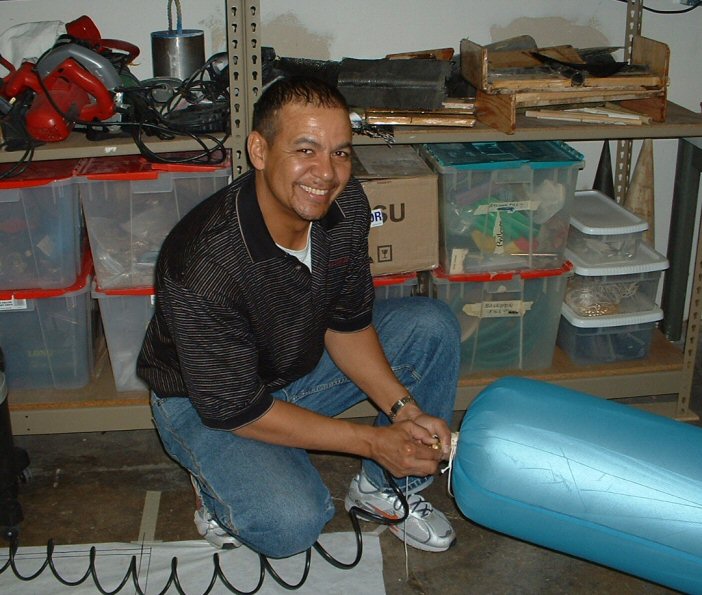
Paul and Emmett working on a rib.
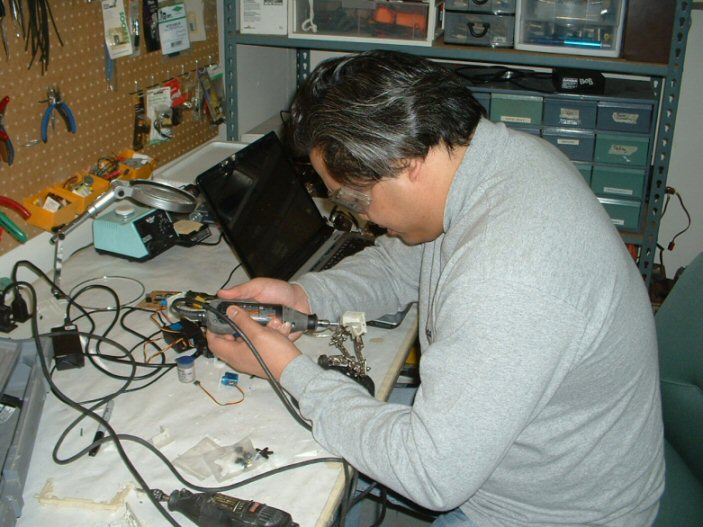

Bob and Anthony working on the reel.
How much is 2 psi in real terms? If you put 2 psi into a plastic bag, would it pop? How stiff would the rib be at that pressure?
A balloon will pop around 0.2 psi. We made an airbeam arch that will support a 50 pound suspended load when it’s at 2.0 psi.
My inflatable canoe body is made of vinyl overlaid with nylon and is designed for 1.5 psi. Are these materials to heavy for your air ribs? I wish you the best of success in your float to space.
We’re using a 2oz per yard outer shell and a thin film poly inner cell. The trick for a very ridged inflated structure is to have a no stretch outer shell and an over sized inner cell.
This is just our test material. We want to get to a 0.4 oz per yard material.
JP
It’s wonderful when things take shape: good luck to you!!!
If I could ask a question. If 50 pounds is your target weight and your suspending the weigh directly below the center of your arch. Would it make any sense to move to multiple inner cells? Iknow there would be a weight trade off, but wouldn’t multiple inner cells be:
1). Easier to buy/manufacture?
2). Redundent achitecture and therefore advantagous to surviving partcial failure?
3). Better at supporting weight than a single cell?